
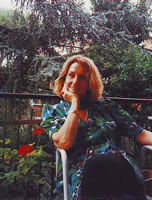
 Born in Giulianova, on the Teramo coast, Vittoria Mazzocca manifested her natural inclination towards the pictorial art and drawing, a family legacy (his maternal grandfather and great-grandfather devoted themselves to painting).
You should therefore not be surprised if already at the end of the fifties, after the paternal family moved to Rome, she exhibited with the "hundred painters" in Via Margutta.
But they are only her first steps.
Her first exhibition was in 1965 at the Roman Art Gallery "Europa Libera", followed the next year by a second one in Rome at the Australian Center "Quantas", which earned her considerable critical acclaim and interest of known Italian and foreign art galleries.
After a brief slowdown in artistic production necessitated by her family commitments - in the meantime she got married and became the mother of three children - starting from the seventies she resumed exhibiting in various Roman art galleries, while her artistic talent opens up new creative fields in ceramics, porcelain and clay sculpture.
Until the eighties, numerous personal and group exhibitions of her followed in various well-known Roman art galleries - including La Pigna, Forum Interart, Arte ed Ecologia, Parioli, Tempio dell'Arte, Il Ponte and others -, for which she receives critical acclaim and achieves significant prizes, among which the "Giorgio de Chirico" Painting Prize as fourth place.
In August 1991 she took part in a group show of paintings and sculptures in L'Aquila, as part of the events surrounding the traditional Celestinian Forgiveness, while in November of that same year she exhibited in Rome at Palazzo Valentini by the Centro d'Arte ed Ecologia, in the presence of the well-known RAI journalist Augusto Giordano and the critic and art historian Anna Iozzino, who in April 1993 dedicated an article to her in the Corriere di Roma, where, among other things, she was highlighted " the formal coherence of each of her works, which is based on an accurate investigation of man as an individual and social being with all his external problems and with the internal ones that arise from the depths".
The year before, in the winter of 1992, Mazzocca had obtained the Targa Colosseo as part of an exhibition curated by the late Roman gallerist Mario Conti in his own art gallery "Forum Interart"; plaque delivered to her by the hands of Augusto Giordano and achieved - it is said in the motivation - for her particular sensitivity in portraiture, landscape and sculpture; and in the spring of that same year she had participated in the third edition of the Expo Arte "Roma Capitale" in the Cinecittà Due complex in Rome with various of her paintings and sculptures.
In this phase her painting appears to be pervaded by lively imagination, marked creativity and great expressive and chromatic richness, while her terracotta sculptures are also enjoying success.
In those same years some photographic reproductions of her works appear in the bimonthly magazine of art, culture and current affairs "Roma allo Specchio".
Still on the crest of the wave, in the summer of 1993 Mazzocca was present at the exhibition curated by the municipal administration of Mosciano Sant'Angelo, in the Teramo area, as part of the local Palio, while the following year, in August 1994, she participates in Giulianova, his hometown, in the tenth edition of the international exhibition of comics and satire, for which he models the bronze plaque which is then delivered to the winner among over 300 humorous designers, the most biting signatures of local and world satire.
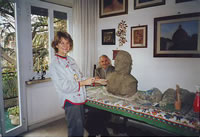
At the end of the nineties her art undergoes an evolution, passing from naturalistic realism, albeit free from schemes, to an increasingly marked surrealism, which presents us with ethereal and diaphanous ghosts joyfully dancing on the sea or hovering in the air in rarefied landscapes .
The human figures, especially in the sculpture, stretch out and point upwards, in a spasmodic and yet composed aspiration towards the infinite.
This new way of her, which ranges from sculpture to painting, has - with the expressive force which the author is capable of - her own message and her own truth to be communicated to the viewer on a subliminal level, involving him in this metaphysical breath.
This second phase of Mazzocca's artistic adventure also permeates the first years of the new millennium up to the present day.